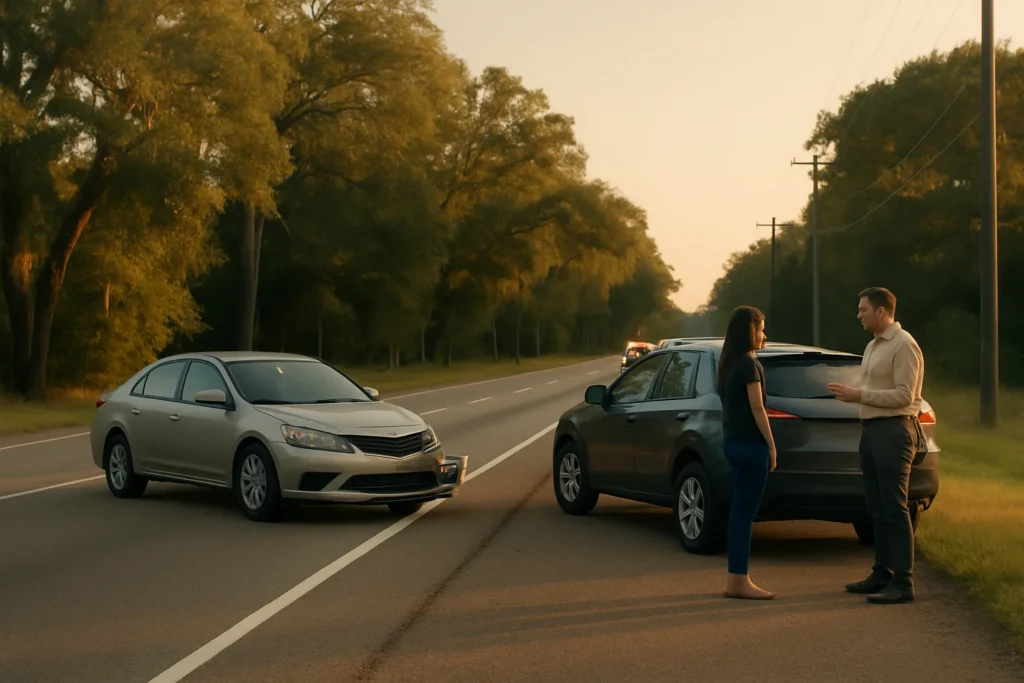
A crash can become more complicated when the other driver has no insurance—or has liability limits that do not cover the full extent of your injuries. If you are asking, “How Do Uninsured Motorist Claims Work After a Jackson, MS Car Accident?” the answer usually begins with your own auto policy, not just the at-fault driver’s coverage.
After a collision in Jackson, you may need to preserve evidence, report the crash, identify every potentially applicable policy, and document your injuries while treatment is ongoing. Jackson car accident claim guidance for injured drivers can provide additional information about those early steps. Ballard Law can help readers understand the coverage and documentation issues that may affect a claim without assuming that every policy or injury case is the same.
This guide explains the difference between uninsured and underinsured motorist coverage, the records insurers commonly review, how communications may affect a claim, and what can happen if the carrier disputes coverage or value.
How an Uninsured Motorist Claim Works After a Jackson, MS Car Accident
Uninsured motorist, or UM, coverage is designed to potentially protect an insured person when a legally responsible driver has no applicable liability insurance. Underinsured motorist, or UIM, coverage may apply when the responsible driver has insurance, but the available liability limits are not enough to address covered damages. The exact result depends on the policy, the facts of the crash, and Mississippi law.
Checking whether UM or UIM coverage applies
A careful coverage review may examine:
- The declarations page and endorsements for the vehicle involved.
- Whether the injured person qualifies as an insured under the policy.
- Whether another household, employer, rental, or resident-relative policy may be relevant.
- The liability limits available from the other driver, if any.
- Exclusions, notice requirements, consent provisions, and other policy conditions.
Mississippi insurance rules govern a Jackson, MS claim, but policy wording and the circumstances of the collision still matter. A person may have potential coverage through more than one policy, while another claim may involve limits, exclusions, or questions about who was occupying the vehicle. A claim against your own insurer is not automatically paid simply because the other driver lacked insurance.
Why the crash investigation still matters
UM and UIM benefits generally do not eliminate the need to establish the other driver’s responsibility and the nature of the damages. Crash reports, photographs, witness information, vehicle damage, traffic-camera footage when available, and medical records may all help support the claim. Coverage questions can also arise if the other driver’s insurance status is unclear or if the parties disagree about how the collision occurred.

Building the Documentation for a Mississippi UM or UIM Claim
An insurer evaluating an underinsured motorist claim in Mississippi may review both liability evidence and proof of injury-related losses. The goal is not merely to show that a collision occurred. The claim file may need to connect the crash to the injuries, explain the treatment received, and document how the condition affected work, household tasks, activities, and daily life.
Records that may help explain the claim
Depending on the circumstances, useful materials can include:
- The crash report, photographs, witness details, and information exchanged at the scene.
- Emergency-room records, diagnostic results, treatment notes, prescriptions, and bills.
- Photographs showing visible injuries or property damage, taken without altering the images.
- Wage-loss information or other documentation of missed work, if applicable.
- A factual symptom or activity journal showing changes over time.
- Information about health insurance payments, medical liens, reimbursement claims, or medical-pay benefits.
This does not mean every record will be decisive, and medical documentation should be interpreted by qualified healthcare professionals rather than guessed at by an insurer or claimant. For practical suggestions about preserving injury evidence, see how to document accident injuries for a UM claim.
Handling medical bills while the claim develops
Treatment and claim negotiations often happen on different timelines. Depending on available coverage and personal circumstances, medical expenses may involve health insurance, medical-pay coverage, provider arrangements, or other payment sources. A person should understand potential liens and reimbursement obligations before resolving an injury claim. Ballard Law’s resource on who pays medical bills after a Mississippi accident discusses these issues in general terms.
A settlement proposal may not account for every future expense or reimbursement issue. Because the value and payment responsibility can change as treatment progresses, the claim should be evaluated using the available records and policy information rather than a quick estimate.
Communicating With the Insurer and Responding to Claim Disputes
In a UM or UIM claim, the insurer may be the injured person’s own carrier, but that does not mean the carrier views every issue from the claimant’s perspective. An adjuster may request a recorded statement, medical authorization, employment information, or additional details about the crash. Requests should be handled accurately and carefully, with attention to whether an authorization is broader than the records reasonably related to the collision.
For more context about insurer communications, review how to handle insurance adjuster calls after a crash. Generally speaking, avoid guessing about facts, minimizing symptoms, posting inconsistent accounts publicly, or signing a release before understanding what claims and policy benefits it affects. These are educational cautions, not individualized instructions; the appropriate response depends on the facts and policy.
Common coverage and claim mistakes
People pursuing a car accident with no insurance in Mississippi may encounter avoidable problems when they:
- Assume the other driver’s lack of insurance ends the inquiry.
- Fail to look for UM or UIM coverage in all potentially relevant policies.
- Delay reporting the collision under the policy’s notice provisions.
- Provide an incomplete medical history or overlook earlier records that an insurer may later request.
- Accept a payment or sign a release without understanding its effect on additional claims.
- Treat an adjuster’s initial valuation as the final measure of damages.
A dispute may involve liability, whether the claimant qualifies as an insured, the amount of available coverage, the relationship between liability and UIM limits, or the extent of damages. If negotiations do not resolve the issue, it is important to distinguish the difference between an insurance claim and a personal injury lawsuit. Court procedures, filing deadlines, and available remedies can depend on the specific claims and should be reviewed with a licensed Mississippi attorney.
Frequently Asked Questions
Can I make a UM claim if the other driver left the scene in Jackson, MS?
Possibly. A hit-and-run may raise uninsured-motorist issues, but coverage can depend on policy language, proof that contact occurred when required by the policy, prompt reporting, and the available evidence. Police reporting and other documentation may be important. Because Mississippi requirements and policy conditions can vary, an attorney may need to review the facts before assessing whether a UM claim is available.
Does UM coverage pay for vehicle damage after a Mississippi crash?
Not necessarily. Uninsured motorist coverage often focuses on bodily injury, while property damage may be addressed through collision coverage or another source, depending on the policy. Some policies may contain separate provisions or limitations. Reviewing the declarations page, endorsements, and applicable Mississippi rules can help clarify what types of losses may be presented.
What if the at-fault driver has insurance, but the limits are too low?
An underinsured motorist claim may be possible when the responsible driver’s liability coverage does not fully address covered damages. The available UIM benefits, offsets, consent requirements, and settlement process depend on the policy and circumstances. It may also be necessary to account for the other driver’s policy before pursuing additional benefits under your own coverage.
Can I pursue a claim against my insurer and the other driver?
Potentially, but the claims serve different purposes and involve different legal issues. The other driver’s liability and your own policy’s UM or UIM obligations may both need evaluation. Settlement with one insurer can affect another claim, particularly if policy limits, releases, or consent provisions are involved. A licensed Mississippi attorney can explain the options specific to the collision.
How Ballard Law Can Help
Ballard Law is dedicated to helping Jackson-area drivers understand the insurance issues that can follow a serious collision. The firm may review potentially applicable policies, investigate liability evidence, organize medical and wage-loss documentation, and evaluate how an insurer is addressing the claim. That process can help identify unanswered coverage questions and clarify the difference between a routine claim communication and a contested dispute.
The firm is committed to fighting for clients’ rights while recognizing that every uninsured or underinsured motorist claim has its own facts, policy language, and legal issues. If you were injured in a Jackson, MS car accident, contact Ballard Law for a free consultation or case evaluation.
The information in this article is for educational purposes only and does not constitute legal advice. Contact a qualified attorney licensed in Jackson, MS; Mississippi for advice specific to your situation.