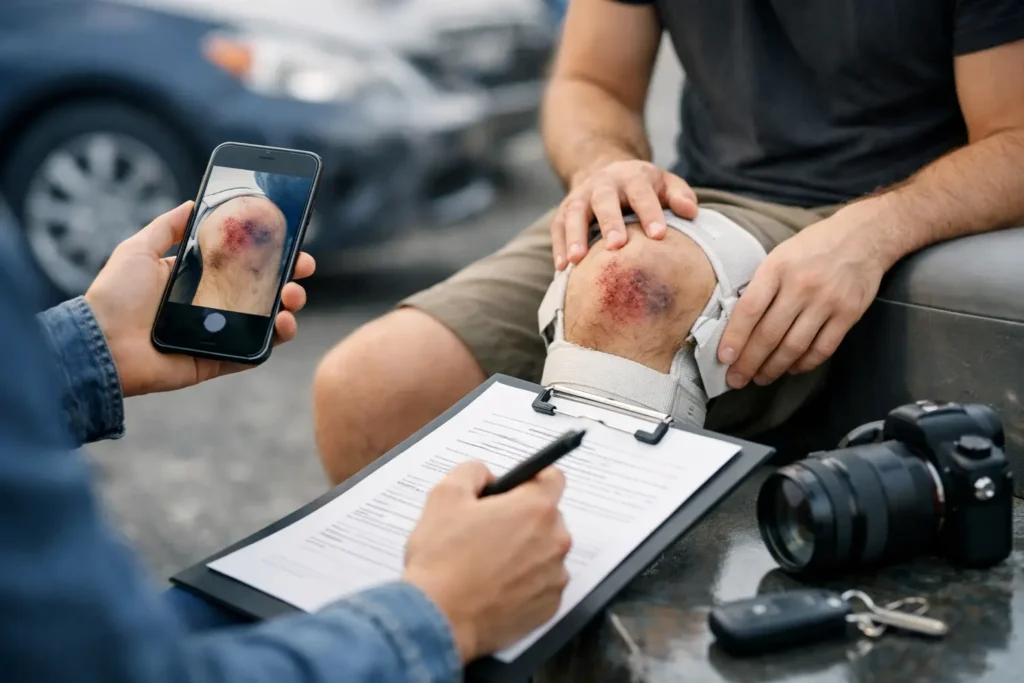
A wreck can leave you shaken, hurting, and focused on getting through the next hour. But the days that follow often determine whether an insurance company takes your injuries seriously. Knowing how to document accident injuries gives you a clear record of what happened to your body, your work, and your daily life – before memories fade and evidence disappears.
You do not need to build a legal case from a hospital bed. Your first job is to get appropriate medical care. Then, as you are able, preserve honest, organized information. The goal is not to exaggerate anything. It is to make sure an insurer, defense lawyer, or jury cannot minimize harm that has been real from the beginning.
Start With Medical Care, Not the Insurance Company
After a car crash, truck collision, fall, or other accident, some injuries are obvious. Others are not. Adrenaline can mask pain, and symptoms involving the neck, back, head, abdomen, or joints may worsen over the next several hours or days.
Get emergency treatment when the situation calls for it. If you are not taken to the emergency room, see a doctor, urgent care provider, or other appropriate medical professional as soon as reasonably possible. Tell the provider every symptom you are experiencing, even if it seems minor at the time. Headaches, dizziness, numbness, sleep disruption, ringing in the ears, anxiety, and pain with movement can all matter.
Be direct about when the symptoms started and whether they began after the accident. Medical records are often the first formal proof connecting an injury to the event that caused it. Waiting too long to seek care can give an insurance company room to argue that you were not hurt, were hurt somewhere else, or made your condition worse by delaying treatment.
Follow the treatment plan you are given unless there is a legitimate reason you cannot. If cost, transportation, work demands, or a scheduling problem prevents you from attending an appointment or filling a prescription, make a note of it and tell the provider. Gaps in care can be explained, but silence lets the other side create its own explanation.
How to Document Accident Injuries From Day One
Your documentation should show the full picture, not just a diagnosis code. A broken bone, concussion, soft-tissue injury, or surgical recommendation carries more weight when the records also show how that condition changed your ability to live and work.
Take clear photographs and video
Photograph visible injuries as soon as possible and continue taking pictures as bruising, swelling, cuts, burns, scars, or surgical wounds develop. Use good lighting. Take a wide photo showing the body area, then closer images that show the injury in detail. If possible, have someone else take the photos so they are clear and include your face or another reference point when appropriate.
Do not use filters, editing tools, or effects. Keep the original files and back them up in more than one place. A simple folder organized by date is enough. Video can also help show limited movement, use of a brace or crutches, or the difficulty of getting around after an injury.
Photographs of the crash scene, damaged vehicles, damaged clothing, safety equipment, and the inside of the vehicle can be valuable too. If you did not take them at the scene, do not put yourself at risk trying to recreate it later. Preserve what is available now.
Keep a daily injury journal
A daily journal is one of the most useful tools available to an injured person. It does not need to be polished. A notebook, calendar, notes app, or voice memo can work. What matters is that you make entries consistently and honestly.
Record your pain level, where you hurt, what activities make symptoms worse, medications taken, sleep problems, medical appointments, and changes in your condition. Include the practical losses people often overlook: needing help getting dressed, missing a child’s event, being unable to drive, struggling to sit through a work shift, or waking up repeatedly because of pain.
Short entries are better than trying to write pages at once. For example: “Tuesday: Neck pain increased after physical therapy. Could not turn my head enough to back out of the driveway. Missed four hours of work for appointment and treatment.” That kind of contemporaneous note can be far more credible than trying to remember months later.
Save every medical and financial record
Create one place for paperwork and digital files. Save discharge instructions, prescriptions, imaging reports, referral orders, therapy notes, bills, receipts, explanation of benefits forms, and mileage records for medical travel. Keep correspondence from health insurers, auto insurers, employers, and medical providers.
Also document lost income. Save pay stubs from before and after the accident, attendance records, disability slips, employer emails, and any paperwork showing missed hours, reduced duties, or time away from work. Self-employed workers should preserve canceled jobs, invoices, appointment logs, and records showing business income affected by the injury.
Do not assume the insurance company already has everything. It may have some information, but its interests are not the same as yours. A complete personal file helps protect against missing records and makes it easier for your attorney to calculate the real cost of the accident.
Document the Injuries That Do Not Show Up in a Photograph
Not every serious injury leaves a visible mark. Traumatic brain injuries, chronic pain, emotional distress, sleep problems, PTSD symptoms, and loss of mobility may not be obvious in a single image. That does not make them less real.
Tell your medical providers about cognitive and emotional symptoms. If you are having nightmares, panic while driving, trouble concentrating, irritability, depression, or fear after the accident, say so. A provider can assess the problem, recommend treatment, and document it properly.
Your journal should also describe changes in relationships and daily independence. If you can no longer lift your child, care for a parent, cook meals, exercise, or participate in activities that were a regular part of your life, write it down. These losses are personal, but they are also part of the harm caused by a serious injury.
Protect Your Credibility While Your Claim Is Pending
Insurance adjusters look for inconsistencies. That does not mean you must stay inside or pretend your life has stopped. It means your statements and public activity should accurately reflect your condition.
Be careful with recorded statements. You can report an accident, but avoid guessing about fault, minimizing symptoms, or accepting a quick settlement before you understand the medical consequences. A polite statement such as “I am still receiving treatment and cannot discuss the full extent of my injuries yet” is often safer than trying to answer every question while you are in pain.
Avoid posting about the accident, your injuries, or your activities on social media. A photo from a brief family gathering can be taken out of context and used to suggest you were not injured. Privacy settings are not a guarantee that a post will stay private.
Do not throw away damaged property, braces, medication containers, or paperwork without first checking whether it could matter. In truck accident cases especially, evidence can move quickly. Vehicle damage may be repaired, electronic data may be lost, and corporate records may not remain available forever.
When Documentation Becomes a Legal Fight
Strong records help, but they do not guarantee fair treatment. Insurers may still dispute fault, question whether treatment was necessary, blame a preexisting condition, or pressure you to settle before you know whether you will need surgery, therapy, or long-term care.
That is where prompt legal guidance can make a difference. An experienced personal injury attorney can gather medical records, preserve accident evidence, communicate with insurers, and push back when a company tries to devalue a legitimate claim. At Ballard Law, PLLC, injured Mississippians can speak directly with an attorney who understands that documentation is not paperwork for paperwork’s sake – it is part of protecting their recovery.
You do not have to have every record perfectly organized before asking for help. Keep getting the care you need, save what you can, and write down what this injury is taking from your life. The clearer the record, the harder it is for the people responsible to pretend the damage was small.