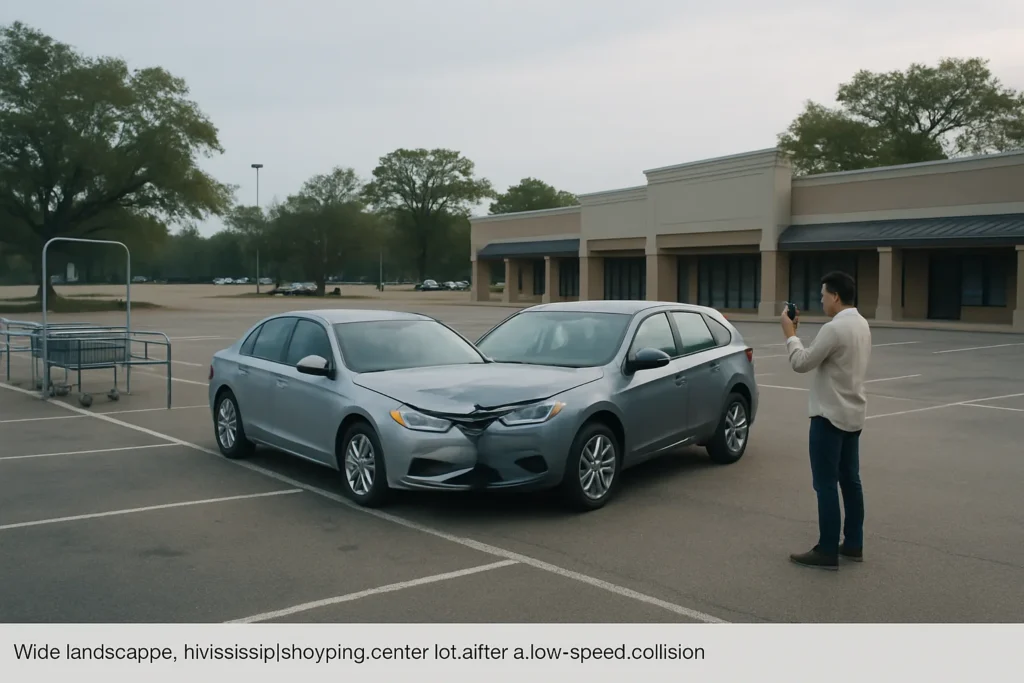
A parking-lot crash can happen in seconds: one driver begins backing out, another vehicle travels through an aisle, and a parked car, pedestrian, cart corral, or visual obstruction limits what either person can see. Because these collisions occur at low speeds and on private property, people sometimes assume the incident is too minor to document. That assumption can make it harder to understand what happened later.
What can a Jackson MS parking lot accident lawyer clarify? Evidence may help establish vehicle positions, direction of travel, visibility, traffic markings, the timing of a maneuver, and whether an occupant’s symptoms appeared after impact. A damaged bumper alone rarely tells the whole story. Photos, witness accounts, surveillance footage, medical records, and a careful account of the scene may provide important context.
Ballard Law can serve as a knowledgeable guide for people evaluating an auto-accident or personal-injury matter. This article explains what drivers and injured occupants may want to preserve immediately, how private-property evidence can disappear, and what common mistakes can complicate a claim. General legal principles vary by jurisdiction and may change, so a Mississippi attorney can assess how the facts apply to a particular situation.
What Evidence Can Clarify a Jackson MS Parking Lot Accident?
The first priority after a collision is safety and appropriate medical attention. Once it is reasonably safe, documentation should focus on preserving the scene as it existed—not on arranging vehicles to make the picture look clearer. In Jackson, MS, a parking lot may have angled spaces, one-way aisles, faded arrows, speed humps, stop signs, or no painted lane lines at all. Those details can affect how people describe the collision.
Photograph the scene before conditions change
Wide photographs can show the relationship between the vehicles, aisle, parking spaces, entrances, buildings, and obstructions. Closer images may capture damage, broken parts, tire marks, debris, paint transfer, and the condition of nearby signs or pavement. If moving a vehicle is necessary for safety, photograph its original position first when possible and note what changed.
Useful documentation may include:
- Each vehicle’s position, direction, and angle after the impact.
- The view from each driver’s seat, including columns, tall vehicles, landscaping, carts, or other blocked sight lines.
- Lane markings, arrows, stop signs, yield signs, parking-space lines, and areas where markings are missing or unclear.
- Damage to vehicles, property, carts, curbs, barriers, or other objects.
- Lighting, weather, surface conditions, and whether the collision occurred near an entrance or busy aisle.
Avoid photographing identifiable bystanders unnecessarily. If a person is a potential witness, asking for contact information may be more useful than posting photographs or commentary online.
Record what you observed while it is fresh
Write down the sequence in neutral terms. For example, note whether a vehicle was reversing, turning, stopped, or traveling through an aisle, but avoid guessing about speed or assigning blame if you did not observe it. Include the approximate time, location within the property, statements made at the scene, and any immediate physical symptoms.
How Do Cameras, Witnesses, and Damage Patterns Help?
Parking lots often contain cameras on stores, banks, apartment buildings, garages, or nearby businesses. The camera may not record the impact directly, but footage can show what happened before and after it. A recording might reveal whether a vehicle entered an aisle, paused, backed from a space, or had a clear or obstructed view. Many systems overwrite footage, and private-property owners may have policies governing whether they release it.
A person involved in a collision may be able to ask the property owner or manager to preserve potentially relevant footage. That request does not guarantee the footage will be provided, and it does not replace advice about preserving evidence through appropriate legal channels. An attorney evaluating a private property car accident may consider where cameras are located, who controls them, and whether footage covers the relevant time period.
Witnesses can also clarify disputed direction of travel or the timing of a backing maneuver. Good witness information includes a name, phone number, location, and a brief description of what the person actually saw. A witness who heard the impact but did not see the vehicles may still help establish timing, but should not be presented as having observed more than they did.
What damage can—and cannot—show
Damage patterns may help compare the vehicles’ points of contact and movement. Scrapes along a side panel, a dent at a corner, paint transfer, or damage to a bumper can be consistent with different collision paths. These observations may support or challenge a driver’s account, but photographs alone do not always establish fault. A qualified professional may need to examine the vehicles or other evidence.
In Mississippi, fault in a parking-lot collision generally depends on the facts and applicable negligence principles. The absence of a marked lane does not automatically decide responsibility, and being on private property does not eliminate the need for reasonable care. Depending on the circumstances, an attorney may evaluate statements, photographs, video, property rules, police or incident reports, and medical documentation together rather than relying on one item.
What Should You Do After a Seemingly Minor Parking-Lot Impact?
Low-speed contact can feel insignificant at first. Stress can mask discomfort, and symptoms may become noticeable later. No one should use an article to diagnose an injury or decide whether medical care is appropriate. If symptoms arise, a healthcare professional can evaluate them and document the person’s reported history and condition.
For claim documentation, it may help to keep an organized record of:
- The date, time, and location of the collision.
- Names and contact information exchanged at the scene.
- Photos, videos, witness details, and information about nearby cameras.
- Conversations with insurers or property representatives, including dates and basic subjects.
- Medical visits, work restrictions, transportation costs, and other accident-related records.
- Changes in pain, mobility, sleep, concentration, or daily activities as reported to healthcare providers.
Common mistakes that make evidence harder to evaluate
One mistake is leaving before exchanging information or identifying witnesses. Another is relying solely on a phone conversation with an insurer and failing to preserve written records. Social-media posts, edited photographs, speculative statements, and estimates about speed can also create confusion. People should avoid altering, discarding, or repairing damaged property before relevant documentation is considered, unless safety or practical needs require it.
A police report may not be available for every private-property collision, and a report is not the only possible source of evidence. In Jackson, MS, the appropriate reporting process can depend on the circumstances and the agencies involved. Generally, an attorney may review whether a report, incident record, insurance file, or other document exists and how it fits with the physical evidence.
If a passenger, pedestrian, or cyclist was hurt, that person’s account and medical documentation may be particularly important. A parking-lot injury attorney in Jackson may also examine whether a property condition, obstruction, or unclear traffic control contributed to the event, without assuming that the property owner or any driver is legally responsible before the facts are investigated.
Frequently Asked Questions
Does a parking-lot crash count as a car accident in Mississippi?
Yes, a collision in a parking lot can still involve a motor-vehicle accident and potential injury or property-damage issues. However, the setting may affect available evidence, reporting practices, and how vehicle movements are interpreted. Private property does not create an automatic answer about fault. The relevant facts may include whether a driver was backing, whether another vehicle had entered the aisle, and what traffic controls or visibility conditions existed.
What if the other driver says I caused the backing accident?
A disagreement at the scene does not by itself resolve responsibility. Preserve photographs, witness details, video information, vehicle damage, and your own factual account. Avoid arguing or making broad admissions based on incomplete information. In a Mississippi backing accident claim, an attorney may compare each person’s description with the vehicles’ positions, points of contact, sight lines, and other available evidence.
Can a store be asked for parking-lot surveillance video?
A store or property manager may control surveillance footage, but access is not necessarily automatic. Footage can be limited by camera angle, retention practices, privacy policies, or equipment problems. Providing the approximate time and location may help identify potentially relevant recordings. Depending on the circumstances, a lawyer may discuss ways to request preservation or pursue evidence through appropriate procedures.
What if I felt fine immediately after the collision?
Some people do not notice discomfort until later, while others have no injury. An article cannot determine what a symptom means medically. If concerns develop, a healthcare professional can evaluate them. From a documentation standpoint, record when symptoms began, how they affect daily activities, and what you report during medical visits. Prompt, accurate records may help explain the timing without requiring speculation.
How Ballard Law Can Help
Ballard Law is dedicated to helping Jackson, MS, drivers, passengers, and other injured people understand the evidence involved in a parking-lot collision. The firm can review available photographs, vehicle damage, witness information, camera locations, medical records, and communications with insurers. Depending on the circumstances, this review may help identify unanswered questions about backing vehicles, blocked sight lines, pedestrians, or unclear markings.
The team is committed to fighting for clients’ rights while explaining the legal process in clear terms. If you are evaluating a private-property car accident or possible injury claim, Ballard Law is ready to evaluate your situation. Contact the firm to request a free consultation and discuss your legal options.
The information in this article is for educational purposes only and does not constitute legal advice. Contact a qualified attorney licensed in Jackson, MS for advice specific to your situation.