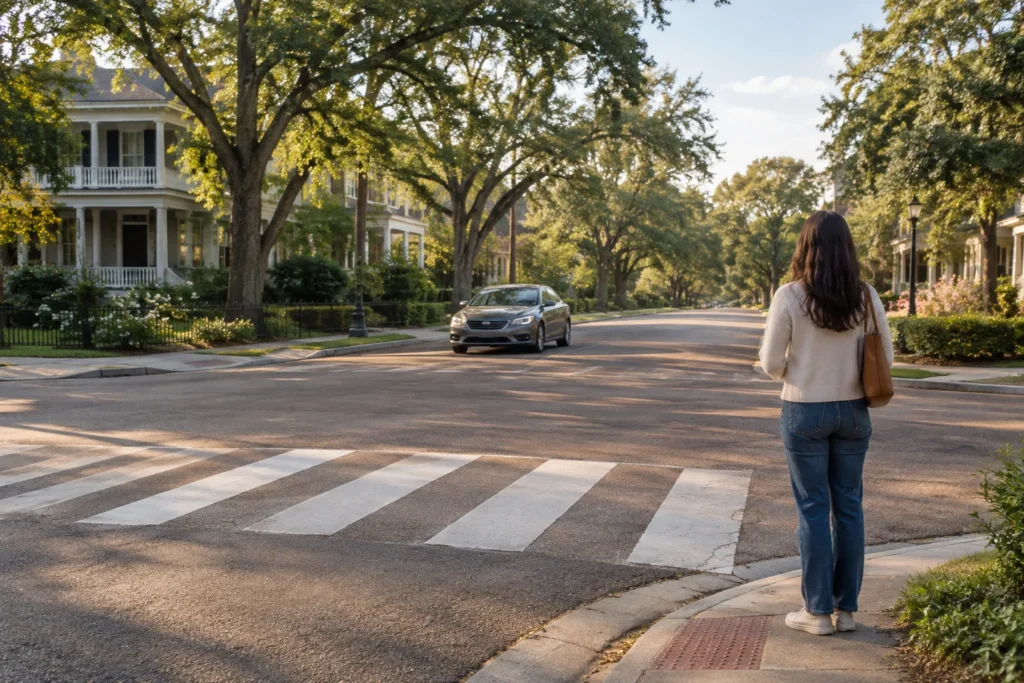
A crosswalk collision can leave an injured pedestrian and their family facing immediate questions: What happened, who may be responsible, and which records might help explain the event? A pedestrian accident claim in Jackson, MS may depend on details such as where the person was crossing, what the driver could see, how the vehicle moved, and whether traffic signals or other conditions played a role. A collision in a crosswalk does not, by itself, resolve every question of fault.
Ballard Law helps readers understand the kinds of evidence and insurance issues that may arise after a pedestrian crash. This article explains how responsibility may be evaluated, what information may be useful to preserve, and what insurance and timing questions could come up. The circumstances of each crash are different, and the available evidence matters.
How a Pedestrian Accident Claim in Jackson, MS Is Evaluated
In a Jackson, MS crosswalk accident, investigators and insurers may consider the full sequence of events rather than relying on one detail. A marked crosswalk, a signal, or a driver’s movement can be relevant, but so can visibility, traffic, lighting, and the location of the impact. Mississippi traffic rules and general negligence principles may apply, and the precise analysis depends on the circumstances.
Visibility, crossing location, and vehicle movement
Useful questions may include whether the pedestrian was within a marked crossing or at an intersection, what the traffic signal showed, and whether parked vehicles, weather, darkness, or other conditions affected sight lines. The direction and speed of the vehicle, braking, turning, and the point of impact may also help reconstruct what occurred. A police report can be one source of information, but it may not answer every question.
For a broader discussion of how evidence and visibility can shape responsibility, see Jackson pedestrian accident fault analysis. No single fact necessarily decides a claim; different accounts or records may need to be compared.
When fault may be disputed
An insurer may ask how and where the pedestrian crossed, whether a signal was present, and what the driver did before the impact. Mississippi comparative-fault principles may also make a person’s conduct relevant to an injury claim. That does not automatically determine the outcome or remove the need to examine the driver’s actions. For more context, review how Mississippi shared-fault rules may affect a crash claim.
What Evidence May Help Explain a Jackson, MS Crosswalk Accident?
Early records can help preserve details that may become harder to recall or locate later. If it is safe and practical, a pedestrian or family member might gather or note:
- Scene photographs: The crosswalk, nearby signals, road layout, vehicle position, lighting, weather, and any visible obstructions. Avoid entering traffic or putting anyone at risk to take pictures.
- Witness details: Names and reliable contact information for people who saw the collision, along with a brief note of what each person observed.
- Available video: Nearby homes or businesses, traffic cameras, or vehicle cameras may have captured part of the event. Footage availability and retention vary, so it may not remain accessible indefinitely.
- Incident information: The responding agency, report or incident reference if available, and the date, time, and location of the crash.
- Medical documentation: Records of evaluations and care, discharge instructions, bills, and receipts related to the injury.
These materials may help fill gaps in accounts of the collision, but they do not guarantee a particular conclusion. If a police report is unavailable, documenting a crash with photographs and witness details can still be relevant to organizing what is known. Keep original files when possible and make a note of when and how items were collected.
Medical records and billing documents serve different purposes: care records describe evaluation and treatment, while bills and payment records help track expenses. Keep copies as care continues, including health-insurance explanations or payment information where available. For a related overview, see who pays medical bills after a Mississippi crash.
Insurance, Claim Timing, and Practical Questions
A pedestrian injury claim may involve more than one potential source of coverage. The driver’s liability policy may be relevant, but the available insurance and applicable terms depend on the people and vehicles involved. If the driver is uninsured or has insufficient coverage, an injured person may want to find out whether a policy available to them could include uninsured or underinsured motorist coverage. Whether it applies can depend on the policy language and facts. See uninsured and underinsured motorist coverage in Jackson for more information.
A person reviewing a claim may also be asked about the collision, injuries, treatment, or other coverage. Records should be accurate and consistent, and questions about what to provide or how policy terms apply may warrant individual legal guidance. Avoid assuming that one insurance policy will cover every expense or that the first account of the event resolves liability.
Timing is another issue to check. Filing deadlines can depend on the type of claim, the parties involved, and other facts; different rules may apply when a government entity is involved. Readers can review Mississippi deadlines for filing a crash claim for general background. Because a deadline may be case-specific, verify it rather than relying on a general online estimate.
Frequently Asked Questions
Does a crosswalk automatically make the driver responsible?
No. A crosswalk can be an important part of the evidence, but it does not automatically establish responsibility. The analysis may consider the signal, visibility, the pedestrian’s location, the driver’s actions, and other circumstances. In Mississippi, a claim may also involve questions about shared fault. An insurer or fact-finder may weigh the available records and accounts before reaching a conclusion.
What if the driver left before I got their insurance information?
The options may depend on what is known about the vehicle and driver and which insurance policies may apply. A police or incident report, witness information, and any available video may help identify details, but they may not be available in every case. An attorney can review the circumstances and explain whether potential coverage, including uninsured motorist coverage, is worth investigating.
Can I pursue a claim if I was not in a marked crosswalk?
Possibly. The precise crossing location may affect how the event is evaluated, but it does not answer every liability question on its own. Relevant details can include the intersection, signals, visibility, vehicle movement, and the conduct of everyone involved. Mississippi law and the specific facts matter, so a general description cannot determine whether a particular claim is viable.
What if my symptoms or treatment needs change after the collision?
Injuries and care can develop over time, and records may be updated as a person receives further evaluation or treatment. Keep copies of relevant medical and billing documents and note important changes or appointments. This is general information, not a medical assessment; questions about symptoms or care should be directed to a qualified healthcare professional. The effect of updated records on a legal claim depends on its facts.
How Ballard Law Can Help
Ballard Law is dedicated to helping injured pedestrians and families understand the evidence and insurance questions that may arise after a Jackson, MS collision. The firm can review available records, consider how crossing location, visibility, vehicle movement, and injuries may relate to a claim, and discuss possible coverage and timing issues. Every matter depends on its own facts, and no particular result can be promised. If you have questions about a pedestrian injury, contact Ballard Law to request a free consultation or case evaluation and discuss your circumstances.
The information in this article is for educational purposes only and does not constitute legal advice. Contact a qualified attorney authorized to practice in the jurisdiction that applies to your matter for advice specific to your situation.