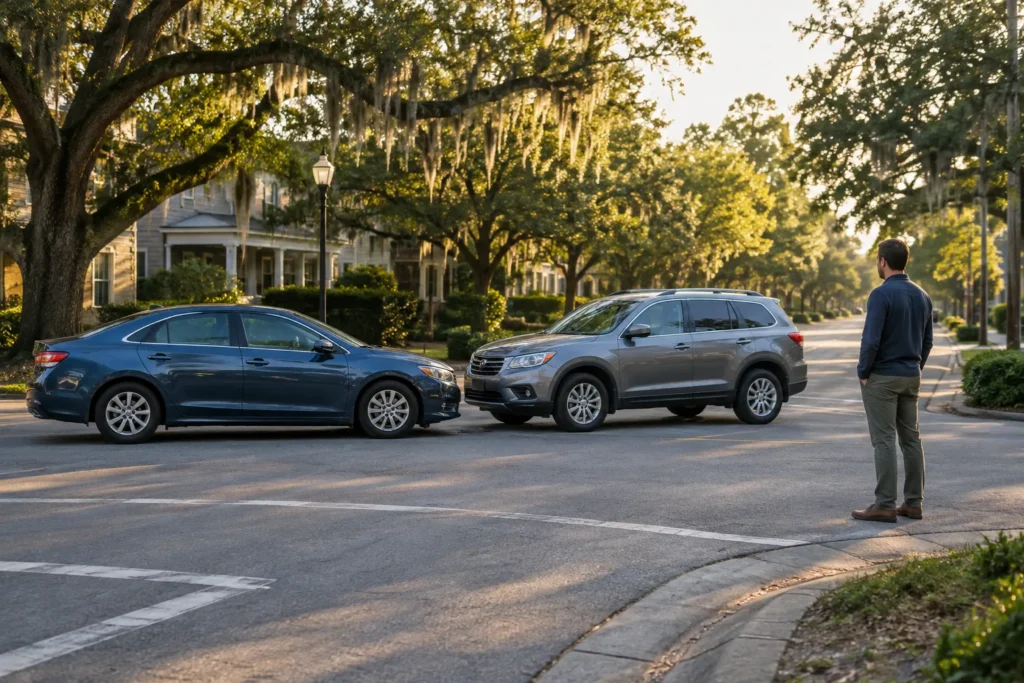
A Jackson collision can leave two drivers with different accounts of what happened. One may say the other entered an intersection against a signal; the other may argue that speed, visibility, or timing played a part. In Mississippi, comparative fault in a car accident can affect how a claim is evaluated when responsibility is shared. The percentage assigned to an injured person may reduce the damages recoverable, so an insurer’s view of the evidence can matter during claim discussions.
Ballard Law helps readers understand the issues that may shape a personal injury claim. This article explains Mississippi’s comparative-fault rule, walks through a straightforward hypothetical, and describes evidence that may clarify each person’s conduct. An insurer’s assessment is not the same as a final court decision, and the result in any particular claim depends on its facts and applicable law.
How Mississippi comparative fault may affect a Jackson car accident claim
Mississippi generally follows a pure comparative-fault approach. If an injured person is found partly responsible for a crash, their recoverable damages may be reduced in proportion to their share of fault. For example, if a factfinder determines that an injured driver was 20% responsible, the damages otherwise established may be reduced by that percentage. The exact effect depends on the evidence, the legal issues in the claim, and how responsibility is ultimately determined.
This rule does not mean that an insurer’s percentage estimate is automatically correct or binding. An insurer may review statements, photographs, reports, and other available information to assess liability for settlement purposes. If a dispute proceeds to court, a judge or jury may evaluate the evidence under the law that applies. For a broader overview, see Ballard Law’s guide to Mississippi’s comparative-fault rules for car accidents.
In Jackson, MS, the practical question is often what each driver did immediately before and during the collision. A fault assessment may consider whether a driver was turning, changing lanes, following too closely, or responding to traffic conditions. A disagreement about one detail can influence how responsibility is viewed, which is why the supporting evidence matters.
How a Jackson intersection hypothetical shows why fault evidence matters
Imagine two cars collide at a Jackson intersection. Driver A says Driver B turned left in front of them. Driver B says the traffic signal had changed and Driver A was moving too fast to stop. Neither account alone settles the issue. Depending on the facts, investigators, insurers, or a court may consider the conduct of both drivers rather than treating the collision as automatically one person’s fault.
Evidence might help clarify what happened, but no single item necessarily answers every question. Relevant information could include:
- Photos of the vehicles, intersection, sightlines, and road conditions taken soon after the crash.
- Names and contact details for people who witnessed the collision.
- Available traffic-camera or nearby business footage, if it exists and can be obtained.
- Vehicle damage and other physical details that may help explain the direction or timing of impact.
- Statements made to responding officers or insurers, considered in context with other evidence.
For more on the kinds of details that may matter when drivers disagree, see this discussion of evidence in a Jackson intersection crash with conflicting accounts. A report from the Jackson Police Department or another responding agency may be useful, but it may not resolve every disputed fact. A lawsuit arising from a Jackson crash may be handled in a court with jurisdiction in Hinds County, depending on the circumstances and applicable procedures.
Preserving evidence and responding to a disputed fault assessment
Evidence can become harder to locate as time passes. Photos may be deleted, video may no longer be available, and memories can fade. Keeping an organized record can help a person understand what an insurer is relying on and identify factual disagreements. In many cases, useful records include crash photographs, witness information, medical records related to the injuries, repair estimates, and copies of communications with the insurer.
If no police report is available, other records may still help document the event. Ballard Law’s guide to ways to document a crash when no police report is available discusses possible sources of information. The relevance and availability of any record will depend on the particular collision.
When an insurer assigns a percentage of fault, it can help to understand the basis for that assessment. The insurer may identify a statement, a scene detail, or another piece of evidence that it believes supports its position. A claimant can compare that explanation with available records and note what remains disputed. If the insurer denies the claim, options after an insurer denies a Jackson car accident claim may help explain possible next steps. Depending on the circumstances, an attorney may review the evidence and discuss potential legal options. No one should assume that a particular fault percentage or outcome is certain before the facts and applicable law are assessed.
Frequently Asked Questions
Can I still pursue a claim if I was partly at fault in a Mississippi crash?
Possibly. Mississippi generally applies comparative fault, which means an injured person’s share of responsibility may reduce the damages they could recover rather than automatically preventing recovery. The effect depends on how fault and damages are established, along with other issues that may apply to the claim. An insurer’s initial assessment is not necessarily the final determination. A licensed attorney can evaluate how the rule may apply to a specific situation.
Does an insurer decide the final percentage of fault?
An insurer may assess fault while deciding how to handle a claim or whether to make an offer, but that assessment is not the same as a final court determination. If the dispute is litigated, the factfinder considers the evidence and applies the relevant law. The parties may also disagree about how evidence should be interpreted. The process and available options depend on the facts, the claim, and applicable Mississippi law.
What if the other driver and I remember the crash differently?
Different accounts are not unusual after a collision, and a disagreement does not by itself establish who was responsible. Photos, witness accounts, available video, vehicle damage, and records created around the time of the crash may help clarify details. In Jackson, the responding agency’s records may also provide useful context, though they may not answer every question. The weight of each item depends on the circumstances.
Can missing video or a police report end a Jackson crash claim?
Not necessarily. A missing report or unavailable video may leave a gap, but other sources—such as photographs, witness details, vehicle records, medical documentation, or insurer communications—may still help explain what occurred. Whether those materials support a claim depends on their content and the disputed issues. A claim’s viability cannot be determined from the absence of one type of evidence alone.
How Ballard Law Can Help
Ballard Law is dedicated to helping people understand the evidence and legal issues that may shape a Jackson car accident claim. The firm can review the circumstances, explain how shared fault may affect a claim, and discuss questions about an insurer’s assessment. Each collision is different, and any guidance depends on the available facts and the law that applies. If you have questions about a crash in Jackson, contact Ballard Law to request a free consultation or case evaluation and discuss your situation.
The information in this article is for educational purposes only and does not constitute legal advice. Contact a qualified attorney authorized to practice in the jurisdiction that applies to your matter for advice specific to your situation.