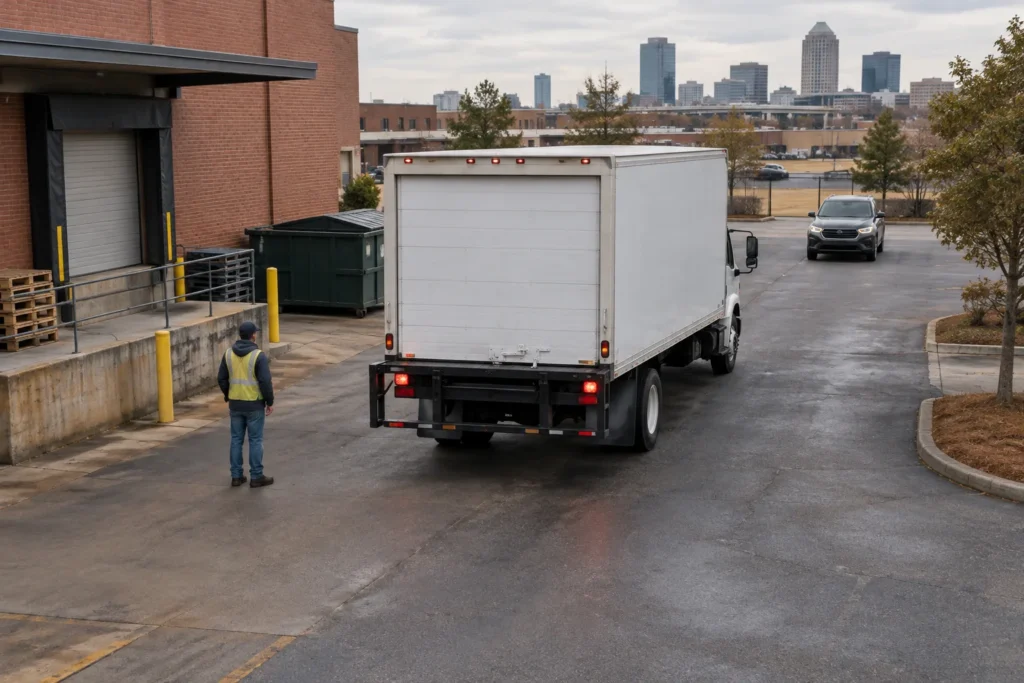
A delivery truck reverses out of a driveway, loading area or parking space while a pedestrian crosses behind it or another vehicle moves through the lot. In seconds, the people involved may be left with conflicting accounts of what each person could see and whether a warning was given. Delivery truck backing accident liability in Jackson, MS depends on the circumstances—not simply on which vehicle made contact.
For people dealing with a truck hit while walking or driving, details about the truck’s path, sightlines, warnings and nearby activity can matter. Ballard Law helps Jackson-area readers understand what may be relevant to a claim. This guide explains who might be responsible, what to document about the location, and how video or other records may help clarify what happened. It also covers shared responsibility and why claim deadlines should not be assumed.
What Determines Delivery Truck Backing Accident Liability in Jackson?
A driver backing a commercial vehicle may need to account for the truck’s blind spots, the available view, the space around the vehicle and the presence of pedestrians or other traffic. A collision does not, by itself, establish who was legally at fault. Investigators may look at whether the driver checked the path, moved cautiously for the conditions, used available warnings appropriately and responded to anything visible behind the truck.
A spotter may be part of a company’s routine or site procedure, but whether one was present—and whether a spotter was reasonably needed—depends on the circumstances. A reverse alarm or camera may also be relevant, though neither proves on its own that the driver could see or avoid a person or vehicle. The vehicle’s size, the backing distance, lighting and activity at the location all provide context.
When a person is struck while the truck is reversing
For a pedestrian, relevant details can include where they were standing or walking, the direction they were moving, obstructions between them and the driver, and whether a warning was audible or visible. Those facts do not automatically assign blame. They help reconstruct the event. This overview of how visibility evidence can affect a pedestrian injury claim explains why scene and movement details may matter.
Who may be responsible?
Depending on the facts, a claim may involve the driver, a delivery company or carrier, a vehicle owner, or a maintenance provider. Investigators may examine work duties, company procedures, vehicle condition and who controlled the location. Not every party is responsible in every collision; the evidence must support a connection to the incident. Read more about potentially responsible parties beyond the truck driver.
What Should You Document at a Jackson Delivery Truck Collision Scene?
The setting can help explain why a backing maneuver became hazardous. If it is safe and practical to do so, photographs or notes may preserve details that change when vehicles leave or activity resumes. In Jackson, MS, a delivery truck parking lot accident may involve private property, a business entrance or a loading area, so record the specific location as clearly as possible.
Useful details may include:
- The truck’s position, direction of travel and apparent backing path, along with the position of any other vehicle or pedestrian.
- Obstructions such as parked cars, walls, shrubs, loading equipment or stacked goods that may have limited anyone’s view.
- Lighting, weather, pavement conditions, painted markings, driveways, entrances and the layout of nearby loading areas.
- The presence and apparent use of a backup alarm, camera, lights, horn or spotter, without assuming that any one feature proves fault.
- Names and contact details for witnesses, if they are willing to provide them, and the time the collision occurred.
These details can help distinguish a clear line of sight from one blocked by the site layout. More guidance on evidence in Jackson parking-lot collisions addresses vehicle movement, limited markings and sightline questions.
Preserving video and truck records
Businesses, property managers and nearby residents may have cameras that capture all or part of a backing maneuver. A recording may be overwritten or retained only for a limited period under the owner’s practices, so identifying possible cameras and asking that relevant footage be preserved promptly can be important. Dash-camera footage or vehicle camera systems may also help, depending on what was installed and retained.
Other potentially relevant information may include driver or delivery records, company policies, vehicle inspection and maintenance records, and electronic data that can help establish timing or movement. Whether those records exist or can be obtained depends on the circumstances. See this guide to commercial truck evidence to preserve after a crash for additional examples.
How Can Shared Fault, Claim Steps and Deadlines Affect a Backing-Collision Case?
A collision may involve more than one contributing factor. The driver’s backing path, a pedestrian’s or other driver’s movement, a spotter’s actions, site design and visibility may all be examined. Mississippi uses comparative-fault principles, so an assessment may consider whether more than one person contributed to an injury. A preliminary statement about fault is not necessarily the final legal assessment. Learn more about Mississippi rules for shared accident responsibility.
After a collision, accounts can differ and some evidence may not remain available. In general, it can help to keep copies of photographs, contact details, incident information and communications about potential video. If an insurer or company asks questions, the information provided should be accurate; the significance of any request can depend on the facts and the policy or claim involved. An attorney may help assess which records are relevant and how to request or preserve them.
Do not assume a single filing deadline applies to every injury claim. Deadlines can depend on the parties, the type of claim and other circumstances; a claim involving a government entity may raise additional considerations. Mississippi rules may also change, so readers should confirm the requirements that apply to their situation. This overview of Mississippi deadlines for a Jackson injury claim explains why relying on a generic timeline can be risky.
For a collision in Jackson, Hinds County may be relevant to identifying the local context, but the proper court and procedures depend on the parties and the claim. Laws vary by location and may change. A lawyer can evaluate the specific facts rather than treating every backing collision as the same kind of case.
Frequently Asked Questions
Does a delivery-truck backing collision have to happen on a public road for someone to bring a claim?
Not necessarily. A collision in a private parking lot, driveway or loading area may still raise questions about responsibility and injury claims. The location can affect which facts matter, who controlled the property and whether any special rules apply. The available evidence and the circumstances of the collision are important, so a private setting alone does not answer whether a claim is possible.
If the truck’s reverse alarm was working, does that settle who was at fault?
No. An operating alarm may be one relevant fact, but it does not establish that everyone nearby heard it or that the driver had a clear view. Investigators may also consider the truck’s speed and path, surrounding noise, lighting, obstructions, the person’s location and whether other warnings or precautions were appropriate. The alarm’s presence should be considered alongside the full scene evidence.
Can a business be responsible if its surveillance video is no longer available?
The absence of a recording does not, by itself, establish responsibility for the collision or explain why footage is unavailable. Video retention practices differ, and cameras may not cover the relevant area. It may still be useful to identify who controlled the camera, what it could view and whether other sources—such as witnesses, photographs or vehicle systems—captured relevant details. The effect of missing footage depends on the circumstances.
What if I was working when a delivery truck backed into me?
An injury at work may involve issues beyond a claim against the truck driver or another responsible party. The facts, your work arrangement and the applicable insurance or benefits can affect which options may be available. Avoid assuming that one process replaces another. An attorney familiar with the relevant Mississippi injury and workplace rules can assess how the circumstances may affect your situation.
How Ballard Law Can Help
Ballard Law is dedicated to helping people in Jackson understand the questions that can arise after a delivery truck backs into a pedestrian or another vehicle. A careful evaluation may consider the truck’s movements, sightlines, warnings, spotter activity, scene layout and available video, as well as which parties may have relevant records. The firm is committed to fighting for clients’ rights while explaining the process and the issues that may affect a claim.
If you were hurt in a delivery-truck backing collision, contact Jackson Mississippi truck accident lawyers to discuss your circumstances. You can request a free consultation or case evaluation and ask whether Ballard Law may be able to help.
The information in this article is for educational purposes only and does not constitute legal advice. Contact a qualified attorney authorized to practice in the jurisdiction that applies to your matter for advice specific to your situation.