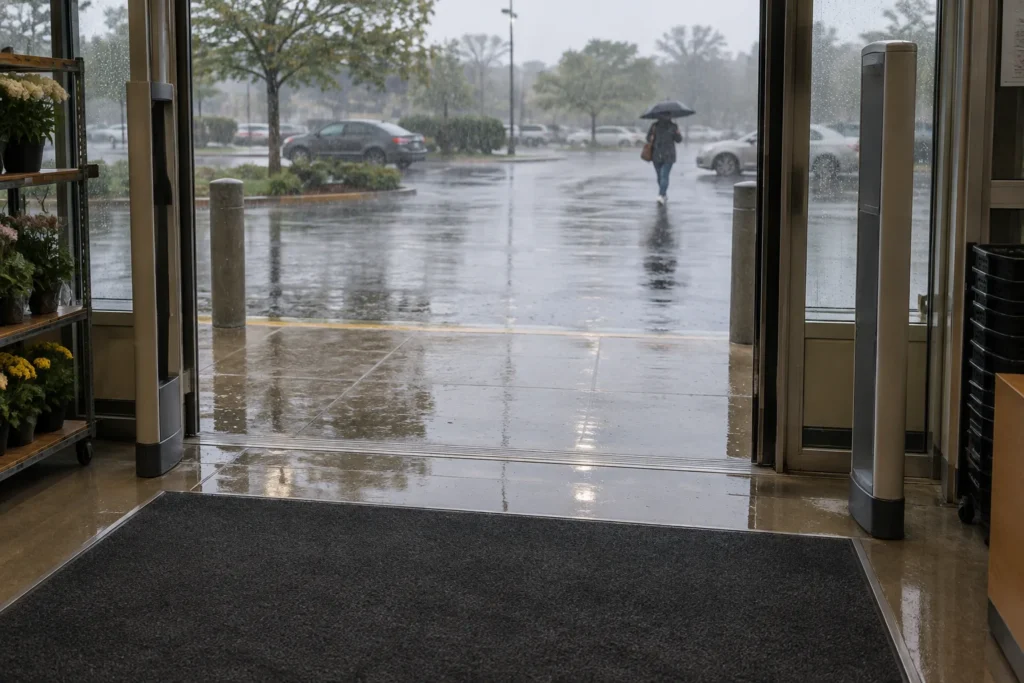
A rainy-day trip to a Jackson store can leave more than a wet umbrella at the door. Water tracked inside may collect on a mat, pool along a floor transition, or spread into a busy walkway. If someone slips, the fact that it was raining does not, by itself, show that a store was negligent. The useful question is what the entrance looked like, how the water got there, and what the business knew or reasonably could have addressed. Readers considering how store liability may apply after a Jackson slip and fall can start with the circumstances surrounding the condition, rather than the weather alone.
Ballard Law helps readers understand how evidence can make those circumstances clearer. This article explains which details to note after an entrance-area fall, how mats, drainage, cleaning, and foot traffic may matter, and what records could help explain the timeline. It also describes why a rainy-day slip and fall in Jackson, MS can present an evidence issue even when the water source seems obvious.
Why a rainy-day slip and fall in Jackson can become an evidence issue
Rain can make an entrance floor wet, but it does not answer the key questions in a premises-injury claim. A useful account considers where the water was, how extensive it was, how long it may have been present, and whether the store took reasonable steps to address the condition. The entrance may have a mat, but its placement, size, condition, and ability to lie flat could also be relevant. None of these details alone determines responsibility; together, they can help explain what happened.
Rain, notice, and reasonable steps
In Mississippi, a store-fall evaluation generally depends on the specific facts, including the condition that caused the fall and what the business knew or had a reasonable opportunity to discover and address. Rain outside does not automatically establish that a store knew about a particular wet spot inside. Evidence about inspections, cleanup, warnings, and the location of the water may help clarify what was happening before the fall.
For a Jackson shopper, that means distinguishing “it was raining” from “water had accumulated at this spot.” A fresh trail of water, a saturated mat, or a puddle near a doorway could prompt questions about how the entrance was managed. A dry or well-positioned mat nearby may tell a different part of the story. The specific facts matter more than assumptions based on weather alone.
Why the exact location matters
A fall just inside the doorway may involve different conditions from one several aisles away. Note whether the person slipped on a mat, on the floor beyond its edge, at a change in flooring, or where water might have been tracked through a customer route. Ballard Law has also covered a Jackson restaurant slip-and-fall dispute. That separate reported matter does not establish anything about a rainy entrance; it illustrates why each business and incident must be assessed on its own facts.
Which entrance details may help explain a wet-floor fall claim?
A practical record focuses on what could be observed, not conclusions about fault. If it is safe and circumstances allow, note the following soon after the fall:
- Rain conditions: Was it raining at the time? Was there visible water on umbrellas, clothing, or the ground outside? Weather records may help establish general conditions, but they cannot show precisely what was on a particular store floor.
- Mat placement and condition: Where did the mat begin and end? Was it flat, bunched, saturated, curled, or shifted away from the main route? Were additional mats present near the entrance?
- Visible water and floor transitions: Describe any puddles, streaks, footprints, damp areas, changes in surface material, or transition strips near the fall location. Avoid guessing how long the water had been there unless there is a basis for that estimate.
- Drainage and entryway design: Note whether the entrance appeared to channel water toward a walkway, whether the floor sloped, or whether water collected near a threshold. These are observations, not proof of a design problem.
- Cleaning and warnings: Were employees cleaning, checking the floor, or placing warning signs? If signs or equipment were present, note where they were in relation to the wet area.
- Crowding or obstacles: Was the route busy, narrow, or blocked by carts, displays, or other objects? Could foot traffic have spread water beyond the mat?
In Jackson, rain showers can make tracked-in water a practical concern for stores and visitors. But a weather report cannot establish the condition of one entrance at one moment. Photos, witness accounts, an incident report, and records of store inspections may each help fill in different parts of the picture. The circumstances will determine what information is relevant and available.
What should someone document after a rainy-day entrance fall?
An accurate timeline can help distinguish what was seen immediately from what was learned later. If a person is able, they may wish to record the approximate time and location, the route taken, the surface involved, and what they noticed about the mat, water, floor transition, lighting, and crowding. Photographs can show context as well as the spot itself—for example, the doorway, the mat’s edges, and the path from the entrance. A photo taken later may not reflect the floor’s condition at the time of the fall, so note when images were captured.
It may also be useful to identify people who saw the fall or the floor beforehand, and to make a record of whom the incident was reported to. Store surveillance video, if available, may be overwritten or otherwise become unavailable under ordinary business practices. A person can ask that relevant footage be preserved, but whether it exists or can be obtained depends on the circumstances. Avoid assuming that a missing video settles the issue.
A report to store staff records that an incident was reported; it does not, on its own, establish how the fall happened or who was responsible. Similarly, seeking medical attention addresses health concerns, but medical records do not necessarily show the condition of the entrance. For additional general guidance, see practical steps to take after a slip-and-fall accident. These steps can preserve observations, but they do not prove negligence by themselves.
For a claim arising in Jackson, Mississippi law and the facts of the particular incident guide the analysis. The appropriate court or process, if a dispute proceeds, depends on factors such as the parties and the nature of the claim; it should not be assumed from the location of the store alone. Laws and procedures can vary and may change, so an attorney can assess how they apply to a specific situation.
Frequently Asked Questions
Can someone document a fall if no one witnessed it?
Yes. A lack of eyewitnesses does not automatically mean there is no useful evidence. The person may be able to record their own observations, identify employees they spoke with, photograph the location if conditions remain similar, and note whether surveillance cameras may cover the entrance. The value of each item depends on its timing and reliability. A witness is one possible source of information, not the only one.
How quickly should a store video request be made?
There is no single timeline that applies to every business or incident, and available footage may be subject to routine deletion or retention practices. A prompt request identifying the date, approximate time, and area may help the store locate relevant footage, but it does not guarantee that a recording exists or will be provided. Depending on the circumstances, an attorney can explain options for requesting or preserving records.
What if the water was not obvious before the fall?
That detail may be part of the evidence, especially if the water was difficult to see because of lighting, flooring, reflections, or foot traffic. A person should describe what they actually noticed and when, rather than assume how long the condition existed. Images, witness accounts, inspection information, and the location of the fall may help clarify the circumstances. The overall facts matter; one observation alone may not resolve a claim.
Does an incident report prove that a store was at fault?
No. An incident report can help document that a fall was reported and may record basic information about the event. It does not automatically establish the cause of the fall, the store’s knowledge of the condition, or legal responsibility. The report may be considered alongside photographs, witness accounts, video, and other available information. Its contents and significance depend on the circumstances and applicable law.
How Ballard Law Can Help
Rainwater at a store entrance can raise detailed questions about the path people used, the floor surface, mats, drainage, cleanup, and timing. Ballard Law is dedicated to helping injured people understand the evidence that may matter in a Mississippi premises-injury matter. The firm can evaluate the circumstances, explain how applicable law may relate to the available information, and discuss possible next steps without promising a particular result. If you experienced a rainy-day fall in Jackson, contact Ballard Law to request a free consultation or case evaluation.
The information in this article is for educational purposes only and does not constitute legal advice. Contact a qualified attorney authorized to practice in the jurisdiction that applies to your matter for advice specific to your situation.